
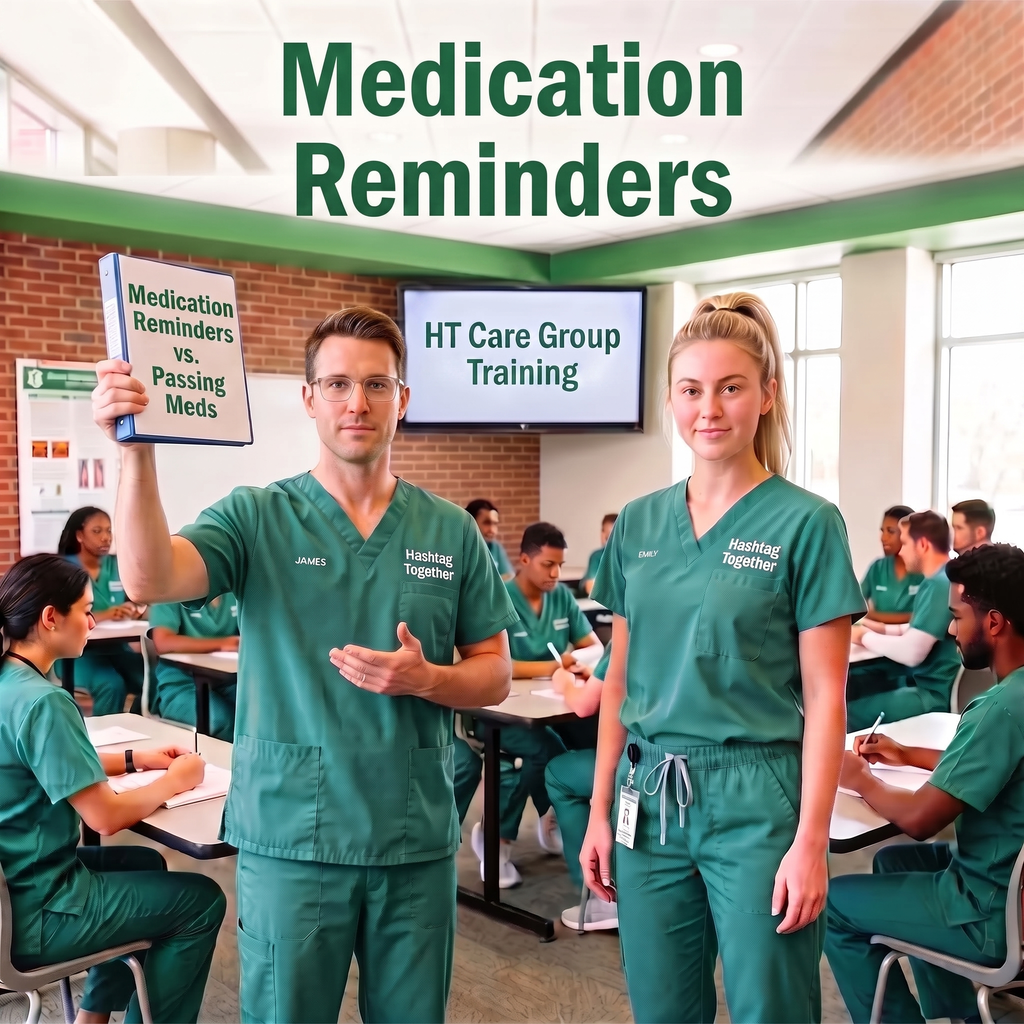
Medication Reminders: Understanding the Role of Non-Medical Home Care Staff
By Hashtag Together Care Group
Medication routines are an important part of many clients’ daily lives. For individuals receiving non-medical home care, caregivers may be present when it is time for a medication to be taken. However, there is an important distinction between reminding someone to take their medication and actually administering or “passing” medication.
Understanding this difference protects the client, the caregiver, and the home care organization.
Key principle: In a non-medical home care setting, the caregiver’s role is generally to support the client’s independence and remind the client to take their own medication—not to take responsibility for administering the medication.
Ohio regulations specifically distinguish assistance with self-administration from medication administration. For example, Ohio’s rules for personal care aide services state that personal care aides do not administer prescribed or over-the-counter medications, but may help an individual self-administer medication, including by reminding the individual when to take it and observing that the individual follows the directions on the container. (Ohio Laws)
What Is a Medication Reminder?
A medication reminder is a simple, supportive activity designed to help a client remember that it is time to take a medication that has already been prescribed to them.
A caregiver may say:
- “It looks like it is time for your medication.”
- “Would you like me to remind you that your medication is due?”
- “Your medication bottle is here. Please check the label and take it as directed.”
- “Would you like me to bring your medication container to you?”
The important point is that the client remains responsible for taking the medication.
The caregiver is supporting the client’s routine rather than making a medical decision or taking control of the medication.
What Does “Passing Meds” Mean?
“Passing meds” is commonly used in healthcare to describe administering medications to a person. It involves much more than simply reminding someone that a medication is due.
Medication administration can involve determining or verifying what medication should be given, the appropriate dose and route, preparing the medication, giving it to the person, and accepting responsibility for the administration and related documentation and monitoring.
For example, if a caregiver takes a pill out of a medication container and places it directly into the client’s mouth, the caregiver is no longer simply providing a reminder. They may be administering the medication, depending on the circumstances and applicable law.
That distinction is critical.
Ohio’s nursing rules expressly state that assistance with self-administration does not mean an unlicensed person can administer medication to an individual, whether orally, by injection, or by another route. (Ohio Laws)
Why Non-Medical Caregivers Do Not “Pass Meds”
Non-medical home care staff are employed to provide supportive services such as personal care, companionship, homemaking, safety monitoring, and assistance with activities of daily living. They are not automatically licensed or authorized to perform nursing functions.
Medication administration can involve clinical judgment and responsibilities that fall outside the normal role of a non-medical caregiver.
There are also important safety considerations.
A caregiver may not know:
- Whether the client should take a medication at that particular time
- Whether the prescription has recently changed
- Whether the medication should be held because of a medical instruction
- Whether two medications could interact
- Whether a dose has already been taken
- Whether a new symptom is a medication side effect
- Whether the medication should be taken with food
- Whether the medication requires a clinical assessment before administration
Those decisions belong with the client and the appropriate healthcare professionals—not with an unlicensed caregiver acting outside their authorized duties.
Reminder vs. Administration: A Simple Comparison
| Medication Reminder | Passing/Administering Medication |
|---|---|
| Reminds the client that medication time has arrived | Takes responsibility for giving the medication |
| Supports self-administration | Administers the medication to the client |
| Client maintains control of taking the medication | Caregiver takes an active role in administering it |
| Caregiver can observe the client following the container directions, when permitted | Caregiver may determine, prepare, or deliver the medication |
| Focuses on independence and routine | Involves a healthcare-related task that may require specific authorization, training, or licensure |
An easy way to remember it:
Remind → Client takes → Caregiver observes/supports.
Not:
Caregiver selects → Caregiver prepares → Caregiver gives.
What Can a Caregiver Do?
Depending on the applicable regulations, the client’s care plan, agency policies, and the caregiver’s authorization, a caregiver may be able to provide limited assistance with self-administration.
Ohio rules provide examples that can include reminding the individual when to take medication, observing the individual to ensure they follow the directions on the container, and handing the medication container to the individual. Certain additional physical assistance may also be permitted under specific circumstances. (Ohio Laws)
This is why HT Care Group caregivers should always follow the client’s service plan, HT Care Group policies, applicable regulations, and their supervisor’s instructions.
What Should a Caregiver Do If the Client Refuses Medication?
A caregiver should not force the client to take medication.
The caregiver can provide the reminder and encourage the client to follow their medication routine. If the client refuses, reports a problem, appears confused about the medication, or says the medication is causing a problem, the caregiver should follow HT Care Group’s reporting and escalation procedures.
The caregiver should not independently decide:
- “You need to take it anyway.”
- “Skip this one.”
- “Take two next time.”
- “This medication doesn’t look right, so I’ll change the dose.”
- “You can take this other medication instead.”
Medication questions should be directed to the appropriate healthcare professional, responsible party, supervisor, or other person designated by the client’s care plan.
What If the Client Asks the Caregiver to Give Them the Medication?
The caregiver should understand the difference between helping someone self-administer and administering medication to them.
If the client says, “Can you give me my pills?” the caregiver should not automatically interpret that as permission to administer medication.
Instead, the caregiver should remain within the permitted scope of their role and follow HT Care Group’s established procedures.
In Ohio, certain specifically authorized home care attendants can assist with self-administration of medications under defined circumstances, including consumer-specific training and written authorization from an appropriate healthcare professional. (Ohio Laws)
That is different from assuming that every non-medical caregiver is permitted to administer medications.
The Importance of Staying Within Your Role
Staying within scope is not about being unhelpful. It is about providing safe, appropriate, person-centered care.
A caregiver can be extremely helpful without administering medication.
For example, the caregiver can:
- Remind the client that medication time has arrived.
- Encourage the client to check the medication label.
- Help maintain a consistent daily routine.
- Bring the medication container to the client when permitted.
- Observe and report concerns according to agency policy.
- Notify the appropriate person if the client reports a medication problem or missed dose.
- Document the reminder or concern according to HT Care Group’s procedures.
The caregiver’s job is to support—not replace—the client’s responsibility and healthcare team.
Remember: “Support, Don’t Prescribe”
Non-medical home care caregivers play an essential role in helping clients remain safe and independent at home. Medication reminders are one way caregivers can support that independence.
The caregiver does not diagnose, prescribe, change doses, decide whether medication should be taken, or independently administer medication unless the caregiver has specific legal authorization, training, and agency approval to perform that task.
When in doubt, stop and ask a supervisor.
HT Care Group’s Medication Reminder Rule
REMIND: Tell the client it is time for their medication.
SUPPORT: Assist with self-administration only to the extent permitted by the applicable rules, care plan, training, and HT Care Group policy.
OBSERVE: When appropriate, observe that the client follows the medication container’s directions.
REPORT: Communicate missed doses, refusals, medication concerns, or unusual observations according to agency policy.
DO NOT PASS MEDS: Do not independently administer medication or make medication decisions outside your authorized role.
Final Takeaway
Medication reminders may seem like a small part of home care, but they represent an important boundary between non-medical support and medical care.
A caregiver’s responsibility is to help the client maintain their routine and independence while respecting the limits of the caregiver’s role. Reminding a client to take their medication is fundamentally different from passing or administering medication.
At HT Care Group, keeping that distinction clear helps protect our clients, our caregivers, and the quality of care we provide.
This article is intended as general staff education and should be used together with HT Care Group’s current policies, client-specific service plans, applicable state/federal requirements, and supervisor direction. Ohio law contains specific exceptions and authorization pathways for certain trained personnel, so “non-medical caregiver” should not be treated as a blanket legal classification for every situation. (Ohio Laws)